Promote tested releases through isolated environments, enforce independent approval, and operate with reversible changes, protected secrets and actionable telemetry.
55 min 195 XPSkills: Release controls, Secrets lifecycle, Runtime monitoring
Brief
At Halcyon Clinics, a billing release passes staging and reaches production at 14:00. At 14:06, failed payments jump from 0.3% to 4%. The developer calls the release approved because they clicked their own approval button. Support enables request-body logging to investigate, accidentally copying authentication tokens into a second system.
Your job is to design the release and runtime controls that would constrain this incident: isolated environments, approval tied to an exact artefact, a tested recovery path, secrets that can be revoked, and monitoring that triggers action. The same records must let an auditor reconstruct who authorised the change, what actually ran, and how the team knew it was safe.
A successful deployment proves delivery, not safety. Approval, recovery and detection are separate controls.
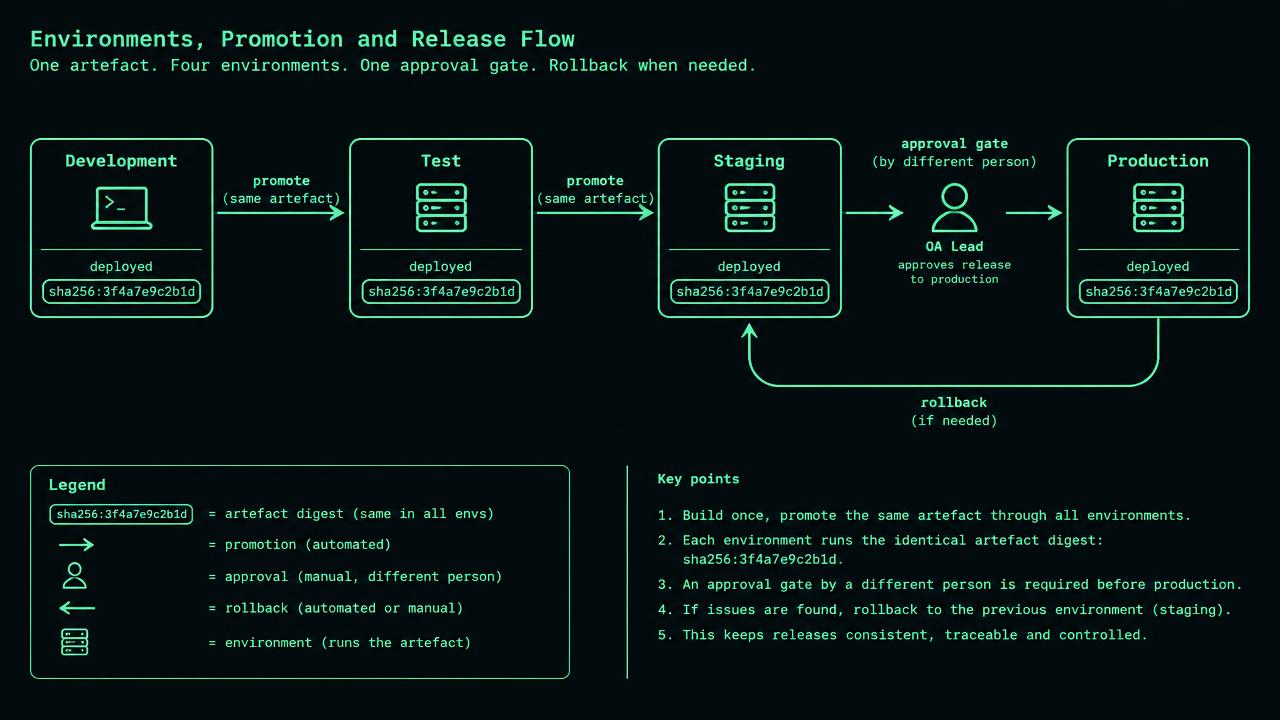
Four environments, one traceable artefact
Development supports rapid edits and local diagnostics; test runs repeatable unit, integration and security checks; staging rehearses production-like configuration, dependency contracts and migrations; production serves real users. These are trust boundaries, not directory names. Give each environment separate identities, credentials and data stores. Use synthetic or irreversibly de-identified test data: copying a production database into staging also copies its privacy obligations.
Build release 42 once, record its cryptographic digest, then promote that same immutable artefact through test, staging and production. Rebuilding after staging changes the object that was tested. Keep configuration separate and validate environment-specific settings, such as callback addresses and database permissions, before promotion. Staging can mimic topology and schema without sharing production credentials or permitting a test identity to connect to production.
Environment separation supports least privilege and change integrity. Preserve test results, configuration versions, artefact digests and deployment identities as linked evidence. An auditor should be able to ask, 'Did the digest tested in staging match the one deployed, and could a test account access live patient data?' and receive records rather than reassurance.
Promote the tested artefact across boundaries without promoting credentials or sensitive data.
Approval, reversibility and feature exposure
A change record should bind the release digest, risk assessment, test results, migration plan, recovery procedure and independent approver. Separation of duties means the author cannot approve their own production change; a deployment service can execute an independently approved plan without becoming the approver. Invalidate approval if the artefact changes. Emergency access needs a named authoriser, restricted duration, recorded actions and prompt retrospective review, not a permanent bypass labelled urgent.
Deployment changes installed code; a feature flag changes which users exercise it. Start a new billing path with 5% of eligible requests, then expand only after an observation window. A flag needs an owner, expiry, safe default and audited changes. Turning it off can mitigate a new path, but cannot revoke leaked credentials, enforce authorisation, or undo database writes. Test both flag states and keep server-side access checks independent of flags.
Define recovery before release: for example, stop expansion when the five-minute payment failure rate exceeds 2%, provided at least 200 requests were observed, and page the on-call responder. Return to a known-good compatible artefact or disable the affected path as the runbook specifies. A destructive schema change may make old code unusable; use expand-and-contract migrations and rehearse compatibility before removing columns. GRC evidence includes approval timestamps before deployment, flag history, a recovery rehearsal and the actual incident response timeline; the audit question is whether recovery was executable, not merely documented.
Secrets have a lifecycle, not a hiding place
A secret is a credential granting authority: passwords, private keys and access tokens belong in a controlled secrets service, never in source code, build output, sample configuration or logs. An environment variable is only a delivery mechanism; process dumps, debug endpoints and excessive read permissions can still expose it. Prefer short-lived credentials retrieved at runtime using a narrowly scoped workload identity, with a different credential for each environment and service.
Rotation means issue a replacement, deliver it securely, verify every consumer uses it, and revoke the old credential. Where supported, a short overlap avoids downtime; do not leave both active indefinitely. If a token reaches a repository, deleting the line does not delete history or invalidate copies. Revoke promptly, inspect usage, replace dependent credentials as needed, and remove exposed material from accessible history using the incident process. Do not paste the token into an incident ticket to prove it leaked.
Secret access records should capture identity, credential reference, operation, outcome and time, never the credential value. Least privilege, expiration and rotation support access management and incident containment. Evidence comprises access policies, issuance and revocation times, consumer cutover checks and anomalous-use review. An auditor may ask whether the old credential still worked after the recorded rotation date.
Log decisions; monitor symptoms and silence
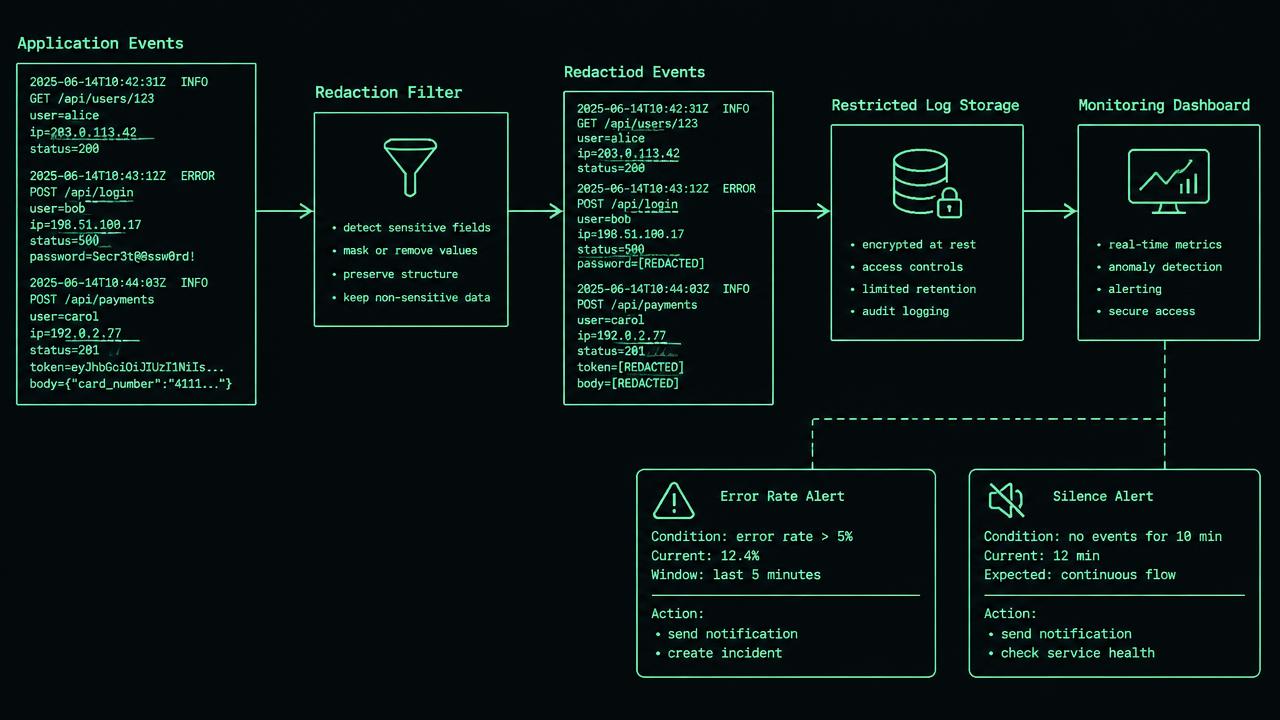
Emit structured security events for authentication successes and failures, authorisation denials, privilege changes, sensitive administrative actions, release and flag changes, and secret-access operations. Record a UTC timestamp, event type, pseudonymous actor or service identity, resource identifier, action, outcome, correlation ID and release identifier. Use stable reason codes rather than raw exception content; sanitise untrusted fields against log injection and restrict who can read or alter records. Set documented retention and disposal periods based on investigation, legal and privacy needs.
Never log passwords, access or refresh tokens, session cookies, private keys, connection credentials or full payment-card data. Avoid raw request bodies and unnecessary personal or clinical data; allowlist specific diagnostic fields and redact before emission. Centralised restricted storage, protected transport, time synchronisation and tamper-resistant retention make events usable as evidence. A correlation ID should be a non-secret identifier, not a session token repurposed for convenience.
Logs are records; monitoring evaluates signals and routes action. Track request volume, error rate, latency and resource saturation, alongside authentication failures, denied access and privileged changes. An alert needs a threshold, window, minimum sample, responder and runbook: 12 failed payments among 300 attempts is 4%, above the 2% release limit. Also alert when an expected telemetry heartbeat disappears; zero errors with zero received events is unknown, not healthy. Test paging and collection-loss detection. An auditor should see the alert firing, acknowledgement and response evidence, not just a dashboard screenshot.
Safe evidence collection and actionable monitoring require both content controls and liveness checks.
Tasks
Answers are graded on the server: the answer key never reaches your browser.
Task 1: The approval that approved itself
Scenario sim+65 XP
Read the brief and answer both questions.
Incident brief
A developer builds release 42, tests it, and approves their own production deployment. The manager calls this separation of duties because the approval and deployment buttons are on different screens. Before production, a separate environment rehearses the release with synthetic data and production-like dependency configuration; the ticket incorrectly calls it development.
Term bank, not all of these are right
separation of dutiesstagingdevelopmentscreen separation
1.1Which control is defeated by author self-approval? (three words)
1.2What environment actually performed the production-like rehearsal? (one word)
Task 2: Installed does not mean exposed
Scenario sim+65 XP
Read the brief and answer both questions.
Incident brief
Release 43 is installed everywhere, but a server-side switch routes only 5% of eligible users through the new billing path. The product lead calls the switch a rollback. When the old and new paths both fail, operations redeploys the previous compatible artefact; no database schema change occurred.
Term bank, not all of these are right
feature flagrollbackapprovalsecret rotation
2.1What mechanism limits exposure without replacing the installed artefact? (two words)
2.2What is restoring the previous compatible artefact called? (one word)
Task 3: The clean file and the silent dashboard
Scenario sim+65 XP
Read the brief and answer both questions.
Incident brief
An engineer commits a service token, then deletes the line and declares the credential safe. The token still authenticates. Separately, the telemetry collector stops sending events at 09:00. A dashboard displays zero errors, and the manager calls that proof of healthy operation. No heartbeat-loss rule exists.
Term bank, not all of these are right
revocationmonitoringfile deletionlogging
3.1What action makes the exposed credential stop authenticating? (one word)
3.2Which capability should detect missing telemetry and trigger a response, rather than merely record events? (one word)
Labs
80 bonus XP
Hands-on work. You edit the artefact, the server runs the checks: the expectations and the reference solution never reach your browser.
Halcyon Clinics is preparing a billing release. The lead says an author can approve because staging passed, and that printing tokens will speed troubleshooting. Neither claim meets the release policy.
Complete the YAML plan using the binding requirements in the fixture. Keep the field structure. The plan must protect production, limit exposure and make its recovery trigger measurable; no real credentials belong in your submission.
Binding release requirements
Target: production; staging rehearsal uses synthetic data and isolated credentials.
Author cannot approve; independent approval required.
Initially expose 5 percent using a feature flag.
Recover to previous compatible artefact if error percentage exceeds 2
across a 5-minute window; require at least 200 requests.
Credential delivery: runtime secrets service; never store secrets in code.
Credential rotation must revoke the old credential after consumer cutover.
Security logs include actor, action, outcome, correlation ID.
Never log passwords or tokens. Page on-call when telemetry heartbeat is missing.
1
2
3
4
5
6
7
8
9
10
11
12
13
14
15
16
17
18
19
20
21
22
23
24
25
Checks
Production and rehearsal boundaries are explicit
Approval cannot be granted by the author
Initial exposure is constrained
Recovery has an executable action and exact trigger
Credential delivery and retirement are safe
Security events are safe and telemetry loss pages a responder
A release coordinator marks all six records compliant because the deployment completed. Review each record against the room's controls; a successful deployment does not waive authority, credential or evidence requirements.
Accept records that demonstrate a safe practice. Reject each unsafe record using the single best reason code: self-approval, irreversible-recovery, credential-exposure, or silent-monitoring.
Verdicts are accept or reject. Every rejection needs one reason code from: self-approval | irreversible-recovery | credential-exposure | silent-monitoring.
Release and runtime review records
AR-1: Release author is the only production approver; approval precedes deployment.
AR-2: Independent reviewer approved digest D42; the deployment record contains D42 and the staging test reference.
AR-3: Recovery relies only on deploying old code after deleting a column that old code requires; no compatibility test or alternate recovery exists.
AR-4: Diagnostic events contain full bearer tokens so support can replay failing requests.
AR-5: Service retrieves its scoped production credential at runtime; rotation verifies consumer cutover before revoking the old credential.
AR-6: Collector has sent no events for two hours; zero errors is treated as healthy and no telemetry-loss alert exists.
1
2
3
4
5
6
7
8
9
10
11
12
13
14
15
16
17
18
19
Checks
Every line in the fixture carries a verdict
Accept and reject land on the right lines
Each rejection cites a valid reason code
Next on your path · Application Fundamentals
Application Fundamentals Capstone
Convert penetration-test evidence into business-ranked risks, testable controls, accountable deadlines and verified remediation.