Classify a system, find the obligations that attach to that class, and turn each one into a control with an owner and an artefact.
50 min 210 XPSkills: EU AI Act, Classification, Compliance
Brief
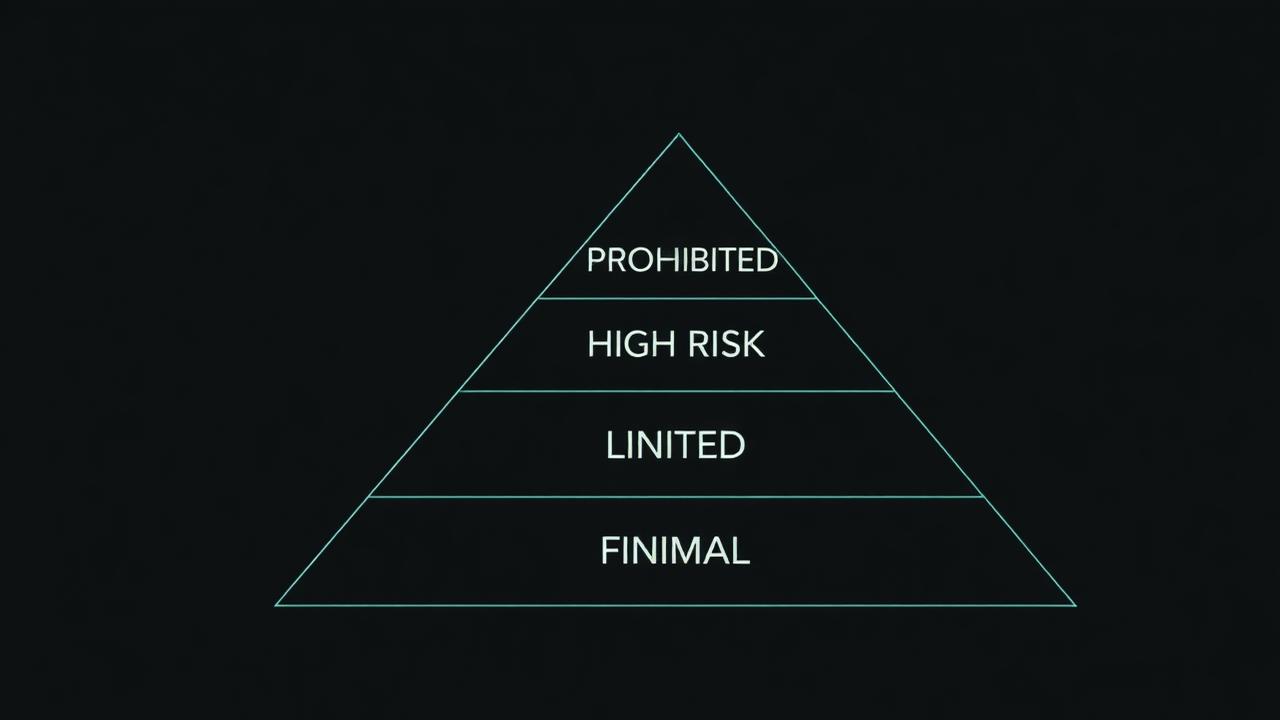
The EU AI Act is risk-tiered: a small set of prohibited practices, a defined class of high-risk systems carrying substantial obligations, limited-risk systems owing transparency, and everything else. Almost all of the work is in one step: deciding which tier a system is in, and defending that decision.
Get the classification right and the obligations follow mechanically. Get it wrong and you are either over-controlling a chatbot or under-controlling a hiring system.
Classification is the control. Everything downstream is bookkeeping against your classification.
Tiers, and where systems actually land
High-risk is defined by use, not by technology. A simple rules engine deciding creditworthiness can be high-risk; a large language model summarising internal meeting notes generally is not. Employment, education, credit, essential services, biometrics and safety components are where the obligations bite.
Role matters too. Provider obligations and deployer obligations differ, and a company that fine-tunes and rebrands a third-party model may take on provider obligations it never budgeted for.
Use decides the tier, not model size, novelty or vendor marketing.
Turning an obligation into a control
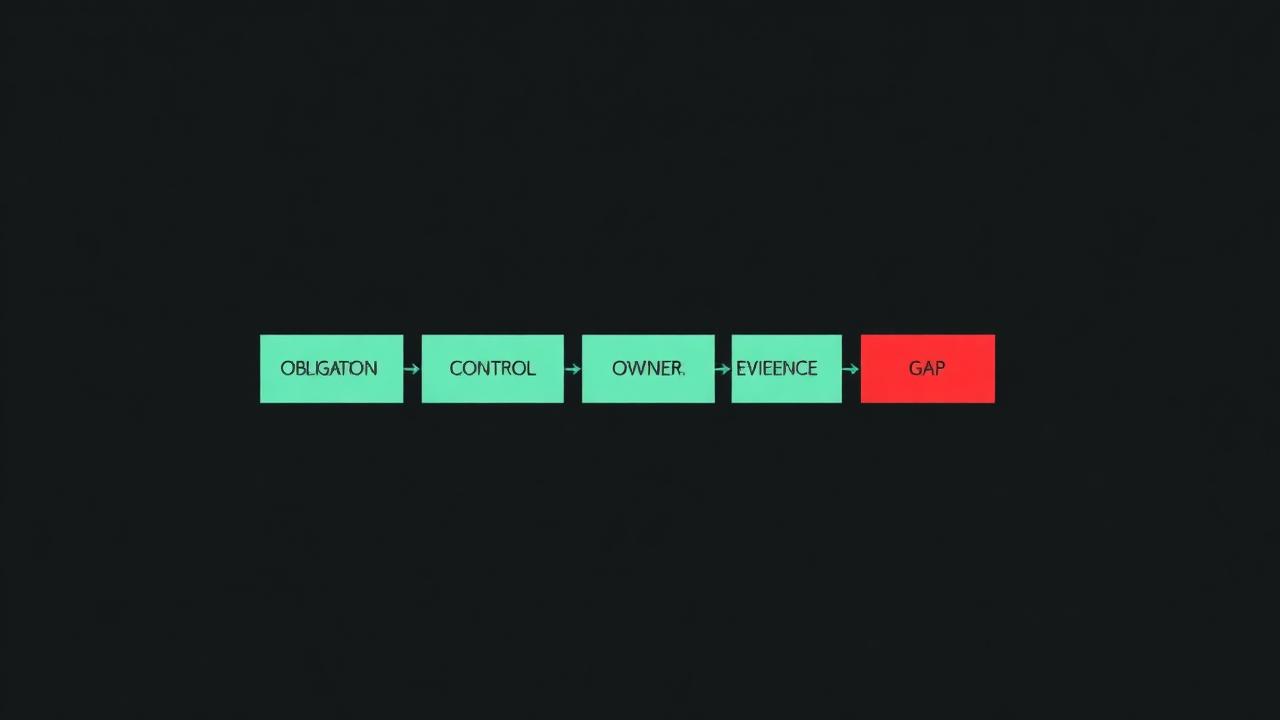
Each obligation becomes a row: obligation → control → owner → evidence. Risk management system becomes a documented, maintained process with dated reviews. Data governance becomes documented training-data provenance and quality checks. Human oversight becomes a named reviewer with the authority and the interface to override. Logging becomes retained, queryable records of system operation.
The row is only finished when the evidence cell names an artefact somebody can fetch.
A row that stops before the evidence cell is a gap wearing a control's clothes.
Oversight has to be real
The most commonly faked obligation is human oversight. A reviewer who sees a decision after it has taken effect, or who reviews four hundred cases an hour, or who has no route to overturn the output, is documentation rather than oversight.
Test it the way an auditor will: how many decisions were overridden last quarter, by whom, and what happened next? A rate of exactly zero is a finding, not a triumph.
Oversight with no override in the log is a rubber stamp with a job title.
Tasks
Answers are graded on the server: the answer key never reaches your browser.
Task 1: It's only a filter
Scenario sim+70 XP
Name the tier this lands in, then what determines it.
Incident brief
Recruiting deploys a keyword scoring tool that ranks applicants and auto-rejects the bottom 40%. It uses no machine learning at all: the vendor describes it as 'a deterministic filter, not AI' and the internal note repeats that phrasing.
Separately, the company runs a large language model that summarises internal engineering meeting notes. The AI committee has spent three meetings on the summariser and none on the recruiting tool.
The summariser has a full risk assessment. The filter has a procurement form.
Term bank, not all of these are right
high riskintended uselimited risktechnologyminimal riskvendor claim
1.1Name the tier the recruiting tool lands in. (two words)
1.2Name what determines the tier. (two words)
Task 2: Four hundred an hour
Scenario sim+70 XP
Name the obligation being faked, then the metric that exposes it.
Incident brief
The benefits-eligibility system requires a human to confirm each automated decision. The confirmation is a single button in a queue; the reviewer's throughput target is four hundred cases per hour.
The interface shows the model's recommendation and a summary, and offers no route to see the underlying application or to record a different outcome without opening a separate ticket.
Last quarter's override count is zero across 92,000 decisions, which the operations lead presents as evidence of model quality.
Term bank, not all of these are right
human oversightoverride ratetransparencyloggingaccuracydata governance
2.1Name the obligation being faked. (two words)
2.2Name the metric that exposes it. (two words)
Task 3: We only fine-tuned it
Scenario sim+70 XP
Name the role the company has taken on, then the obligation that now applies.
Incident brief
The company licenses a third-party model, fine-tunes it on its own data, puts its own name on the product and sells it to hospitals for triage support.
Legal's position is that obligations sit with the original model vendor because 'we did not build it'. The contract with the vendor is a standard SaaS agreement with no AI-specific terms.
The engineering team cannot produce documentation of what the fine-tuning data contained.
The register row for the applicant ranking tool reads: tier minimal, basis "vendor states it uses no machine learning", role deployer. The company licenses the model, fine-tunes it on its own data, rebrands it and sells it.
Fix the row. Classify on intended use, record the role the company actually holds, and turn each obligation into a line with an owner and an evidence artefact that exists.
System facts
system   : applicant ranking; ranks candidates and auto-rejects the bottom 40%
build    : third-party model licensed, fine-tuned on company data, rebranded, sold on
vendor   : "a deterministic filter, not AI"
oversight: recruiters may overturn any rejection; overrides logged; 3.1% last quarter
artifacts available:
  training_data_provenance.md, oversight_override_log, system_operation_logs
1
2
3
4
5
6
7
8
9
10
11
12
Checks
The tier reflects the intended use
Classification is based on use, not technology
The company's role under the Act is correct
Obligations carry an owner and an evidence artefact
The AI Act register is being reviewed before it goes to the board. Each row records a system, its tier, the company's role, and the obligations that follow.
Accept the rows that would hold up in front of an assessor. Reject the rows whose classification, role or evidence will not.
Verdicts are accept or reject. Every rejection needs one reason code from: classified-by-technology | wrong-role | oversight-nominal | no-evidence-artifact.
ai_act_register.yaml: rows under review
Z-1  Applicant ranking tool: classified high risk on the basis of intended use (employment screening), with a named owner.
Z-2  Keyword CV filter that auto-rejects the bottom 40%: classified minimal risk because the vendor states it uses no machine learning.
Z-3  Customer support chatbot: limited risk, transparency notice deployed, artefact linked in the row.
Z-4  Licensed model fine-tuned on company data, rebranded and sold to hospitals: recorded as deployer, obligations assigned to the vendor.
Z-5  Benefits eligibility: human oversight satisfied by a confirmation button; reviewer throughput target 400 cases per hour, no route to record a different outcome.
Z-6  Data governance obligation for the triage model: owner named, evidence cell reads "to be defined".
1
2
3
4
5
6
7
8
9
10
11
12
13
14
15
16
17
18
19
Checks
Every line in the fixture carries a verdict
Accept and reject land on the right lines
Each rejection cites a valid reason code
Next on your path · AI & Advanced
Scaling a GRC Engineering Function
Team shape, intake, platform versus project work, and the metrics that tell you whether the function is compounding or just busy.