Understand rpo and rto, raid limits, restore assurance and test the resulting controls with reproducible evidence.
45 min 210 XPSkills: RPO and RTO, RAID limits, Restore assurance
Brief
Northwind Freight needs defensible evidence for backup and recovery, not a vocabulary quiz. Start with the system boundary and trace how a technical state changes the confidentiality, integrity or availability of the service. A passing document is not a passing running system.
You will examine rpo and rto, raid limits, restore assurance, then make short incident decisions and author a testable specification. Keep desired state, observed state and evidence separate: an approved requirement tells you what should happen, while a dated observation tells you what actually happened.
Never convert missing evidence into a passing control result.
Recovery targets are different clocks
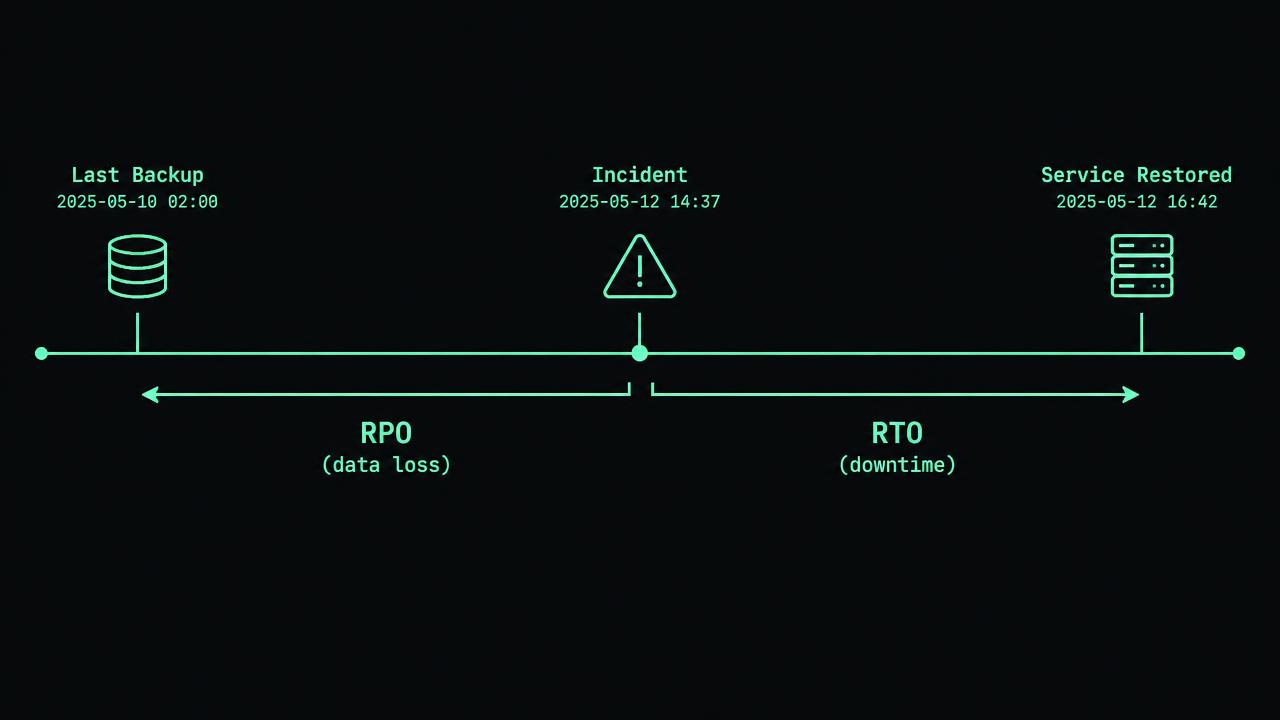
Recovery point objective is the maximum acceptable data-loss interval, while recovery time objective is the target duration to restore service. If usable backups occur every four hours, the schedule alone cannot support a one-hour RPO. Include replication delay and failed jobs when determining the age of the last recoverable point.
Measure RTO through declaration, provisioning, data restoration, dependency checks and business acceptance. A restore command taking 20 minutes does not prove a 30-minute service RTO if identity and network recovery take another hour. Set targets through business impact analysis and test the actual dependency sequence.
Continuity controls need approved RPO/RTO values and timed exercises. An auditor asks which business transaction confirmed recovery and how much committed data was missing from the recovered system.
Recovery targets are different clocks requires both a declared boundary and independently testable observations.
Redundancy does not replace backup
RAID 0 stripes data for capacity and performance without redundancy. RAID 1 mirrors data; RAID 5 uses distributed single parity and tolerates one member failure, while RAID 6 uses dual parity and tolerates two. RAID 10 stripes across mirrors; its failure tolerance depends on which mirror members fail.
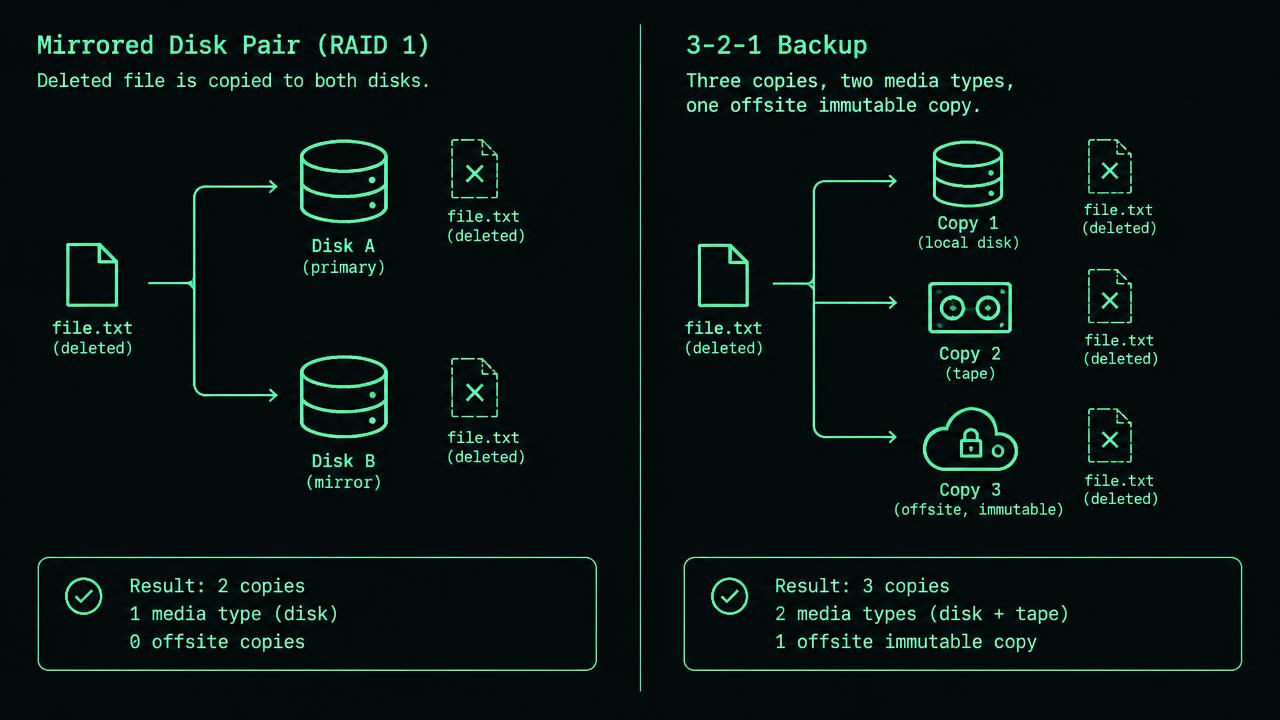
RAID can preserve availability after some disk failures, but propagates deletion, corruption and malicious encryption. Rebuilds consume resources and expose remaining members to additional risk. A redundant array is one logical copy in one failure domain, not an offline historical recovery point.
Resilience controls need array health, failed-member alerts and independent backups. An auditor asks whether a privileged deletion on the source can also destroy every supposed recovery copy.
Redundancy does not replace backup requires both a declared boundary and independently testable observations.
Copies, isolation and restore testing
The 3-2-1 principle calls for three copies, on two distinct media types, with one offsite copy. Treat independence as a design question too: separate credentials, offline or immutable retention and geography reduce correlated loss. Merely placing three folders on the same device does not meet the intent.
A backup-success event proves a job ran under its own definition, not that data and dependencies can be restored. Test decryption keys, catalogue availability, application consistency and representative records in an isolated environment. Restore testing must not overwrite production or expose protected data to a weaker environment.
Recovery evidence needs backup identifiers, timestamps, restoration logs and integrity checks. An auditor asks for a failed test and its remediation as well as the successful demonstration, and whether the measured recovery met both targets.
Tasks
Answers are graded on the server: the answer key never reaches your browser.
Task 1: The two recovery clocks
Scenario sim+70 XP
Read the brief and answer both questions.
Incident brief
Business accepts at most one hour of lost transactions and four hours before service returns. The owner calls both values backup frequency.
Two disks hold identical live writes; accidental deletion is copied immediately. The owner calls the mirror an offline backup, and proposes striping without redundancy as equally fault tolerant.
Term bank, not all of these are right
RAID 1RAID 0RAID 5RAID 6
2.1Which level describes the two-disk mirror? (two tokens)
2.2Which level stripes without redundancy? (two tokens)
Task 3: Copies without a test
Scenario sim+70 XP
Read the brief and answer both questions.
Incident brief
The plan requires the 3-2-1 principle, but only two copies exist. The job reports success and the owner calls that proof of recovery, although no isolated recovery has run.
Term bank, not all of these are right
3restore test2RAID check
3.1How many copies does the principle require? (a number)
3.2What exercise demonstrates actual recoverability? (two words)
Labs
80 bonus XP
Hands-on work. You edit the artefact, the server runs the checks: the expectations and the reference solution never reach your browser.
The control owner calls the current summary complete because every field has a label. Several labels confuse a technical mechanism with assurance, and missing observations have been treated as passing.
Use the fixture as the authoritative requirement. Replace the empty fields with typed, testable values and identify the evidence needed to substantiate the claim. Do not copy the owner's optimistic summary.
Approved requirement and measured facts
Business accepts at most 60 minutes data loss and 240 minutes recovery time. Plan 3 copies with two media types and one offsite copy. Evidence requires isolated restore and integrity check.
The coordinator calls every line critical because it contains security terminology. The queue includes normal observations and verified changes as well as actual defects.
Use this exercise scale: active destructive compromise is critical; a confirmed unauthorized modification path is high; an isolated test coverage gap is medium; verified-state documentation hygiene is low. Informational verified observations are noise.
List only the lines that qualify, worst first. Severity is one of: critical | high | medium | low. Add or delete rows as needed.
Observed events with scope and impact
IT8-1  ACTIVE: attacker-controlled account is currently deleting the sole rpo and rto evidence copy; stop ongoing destruction.
IT8-2  EXPOSED: unauthorized users can modify raid limits configuration; exploit path confirmed, no current exploitation.
IT8-3  LIMITED: one isolated test node lacks a required restore assurance observation; production unaffected.
IT8-4  HYGIENE: documentation heading for rpo and rto is stale, but measured state and coverage are verified.
IT8-5  Recovery point objective is the maximum acceptable data-loss interval, while recovery time objective is the target duration to restore service. Verified informational baseline observation, no gap.
IT8-6  RAID 0 stripes data for capacity and performance without redundancy. Verified informational mechanism observation, no gap.
IT8-7  Scheduled collector heartbeat received within the approved window; no missed collection.
IT8-8  Approved maintenance completed with independent post-change evidence and no unresolved finding.
1
2
3
4
5
6
7
8
9
10
11
12
Checks
The right findings are raised
Benign lines are left out
Severity matches the actual exposure
Ranked worst first
Next on your path · IT Fundamentals
IT Fundamentals Capstone
Understand estate audit, control testing, evidence pack and test the resulting controls with reproducible evidence.