At Halcyon Clinics, a replacement reception switch goes live at 08:00. Ten minutes later, appointment terminals lose their gateway intermittently. A technician calls it a collision storm; the security lead says the clinical VLAN is a firewall. Packet captures show changing gateway MAC mappings, while a spare cable connects two wall outlets back to the same switching fabric.
You must separate three questions: where frames travel, who can impersonate a local neighbour, and which device actually permits a routed connection. This room follows frames through a switch, resolves an IPv4 neighbour with ARP, and designs VLAN and spanning-tree safeguards. Configuration exports, time-stamped tables and permitted/denied traffic tests become evidence rather than reassurance from a network diagram.
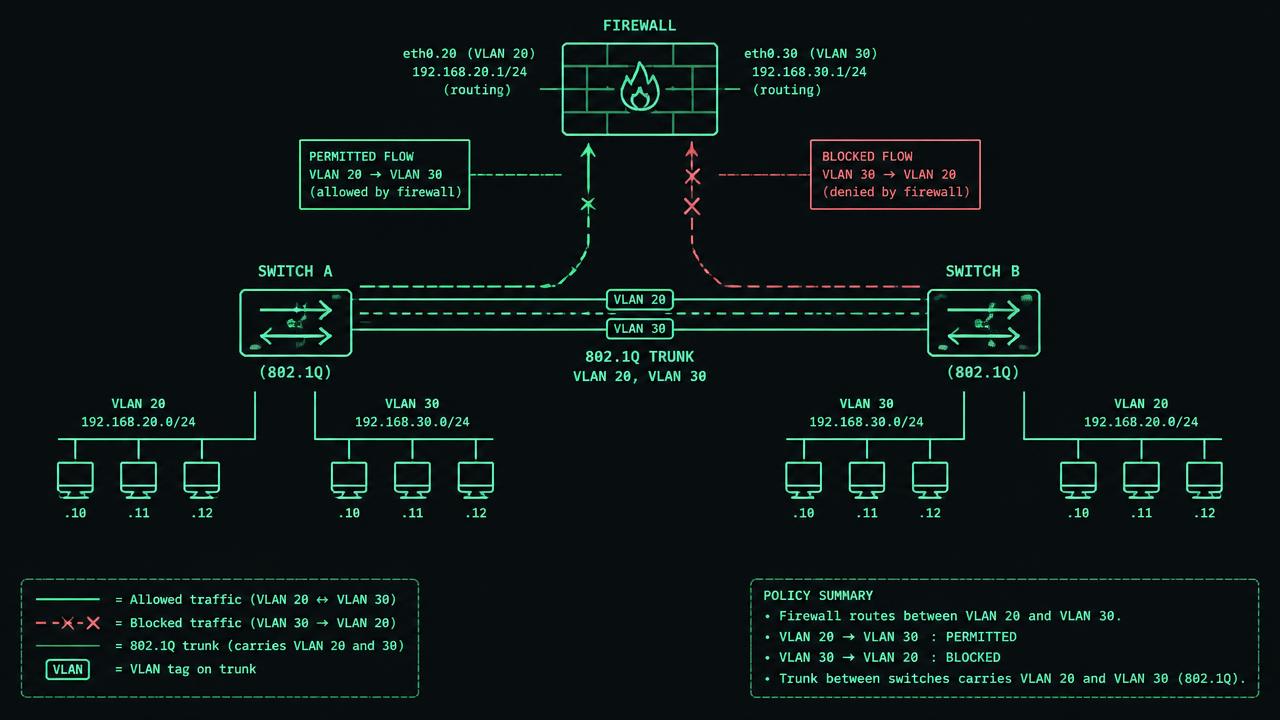
A VLAN limits Layer 2 reachability; it does not authenticate a host or decide which routed application connections are allowed.
Learn the source, forward by the destination
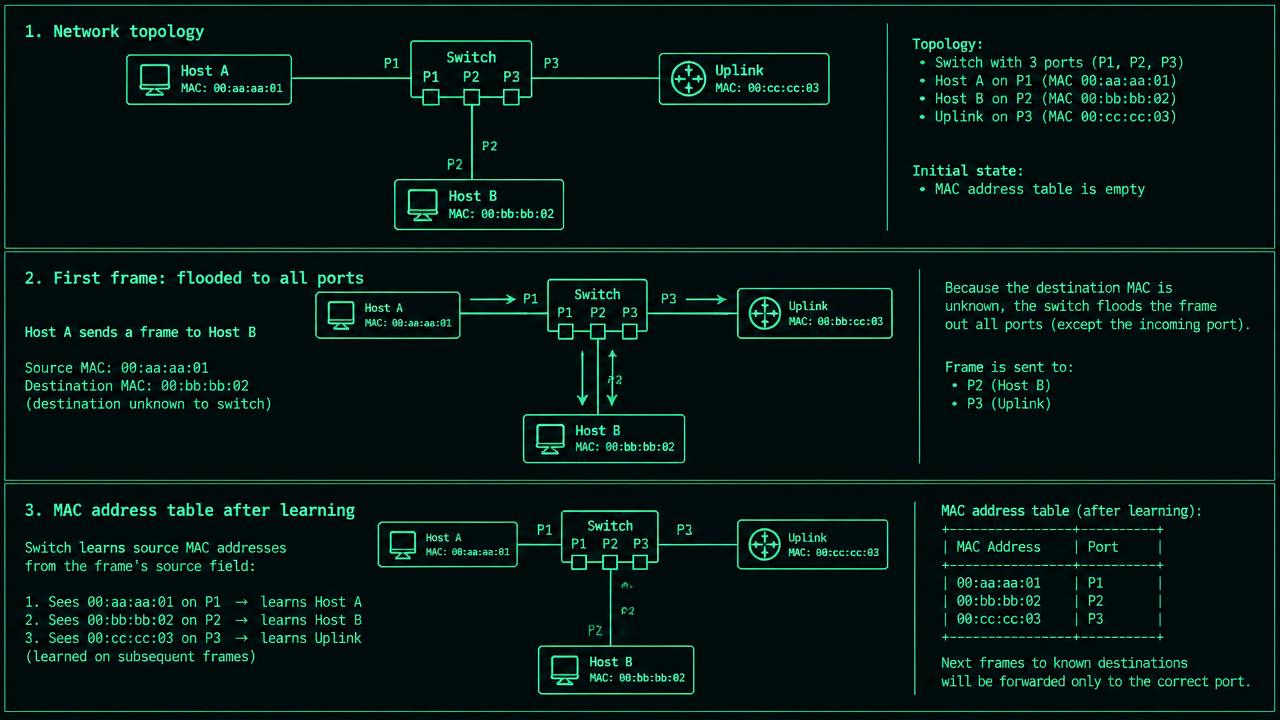
Ethernet uses 48-bit MAC addresses, commonly written as six hexadecimal octets, such as 02:00:00:00:00:0a. They identify link-layer interfaces, not trustworthy people: software can change them, and locally administered addresses need not identify a manufacturer. An ordinary Ethernet switch learns the source MAC and ingress port of a valid frame within its VLAN. Its forwarding table is effectively keyed by VLAN plus MAC, with dynamic entries removed after an aging interval.
Suppose VLAN 20 has terminal A on p1, terminal B on p2 and an uplink on p3. A sends to B while the table is empty: the switch learns A on p1, then floods the unknown unicast to p2 and p3, not back to p1. B replies; the switch learns B on p2 and sends the reply only to p1. Later known unicasts use the learned destination port; a destination learned on the ingress port is filtered. Flooding is not broadcasting: an unknown unicast retains B's destination MAC. Broadcast frames use ff:ff:ff:ff:ff:ff and are flooded within the VLAN.
For asset and segmentation controls, retain a time-stamped MAC table with VLAN and port configuration, but do not treat it as proof of identity or a full inventory: silent devices and aged entries disappear. An auditor can ask whether an unfamiliar MAC on a clinical port is an authorised endpoint; answering requires inventory and admission evidence beyond the learned table.
The switch learns from source addresses and confines unknown-destination flooding to the ingress VLAN.
Broadcast domains, collision domains and ARP deception
A VLAN is a Layer 2 broadcast domain, even when it spans several switches over trunks. A router normally does not forward Ethernet broadcasts between VLANs. A legacy shared half-duplex segment forms one collision domain; switches separate those segments by port. On modern point-to-point full-duplex Ethernet, collisions do not occur and collision detection is not used. A broadcast storm can therefore saturate perfectly collision-free links. Count broadcast domains by active VLANs, not by the number of switches or cables.
ARP resolves an IPv4 next-hop address into a MAC on the local link. A host in 10.20.0.0/24 seeking 10.20.0.1 sends a broadcast request, then normally receives a unicast reply and caches the mapping. To reach a different subnet it resolves its gateway, not the remote server's MAC. ARP has no built-in authentication: a forged reply claiming that the gateway address belongs to an attacker's MAC can redirect or discard traffic. This is ARP spoofing, not a DNS change, and it can happen between hosts inside one VLAN.
Controls include ARP inspection against trusted address bindings, carefully limited trusted uplinks, and explicit bindings for static hosts where required. Address-assignment snooping can supply dynamic bindings, but a static printer may need separate treatment. Preserve neighbour-cache changes, binding tables and inspection drop logs with timestamps. The audit question is whether a forged gateway claim is actually rejected, not merely whether an inspection feature is enabled somewhere.
Carry VLANs without confusing separation with permission
An access port normally assigns untagged endpoint frames to one configured VLAN. An IEEE 802.1Q trunk carries several VLANs using a 4-byte tag containing a 12-bit VLAN identifier; ordinary VLAN IDs range from 1 to 4094. VLAN 20 and VLAN 30 can share one cable without sharing broadcast traffic. Explicitly allow only required VLANs on each trunk and configure endpoint ports as access ports rather than allowing automatic trunk negotiation.
In common trunk configurations, the native VLAN carries untagged frames. If one end assigns those frames to VLAN 20 and the other to VLAN 30, identical untagged traffic crosses an unintended boundary. Native tagging behaviour depends on configuration; verify both ends. Use a consistent unused native VLAN with no endpoint ports, tag native traffic where supported, and prune unnecessary VLANs. These measures reduce misclassification and some VLAN-hopping opportunities; they do not turn tags into authentication.
Traffic between VLANs requires Layer 3 forwarding, but a router with routes alone may permit all such traffic. Enforce least privilege using firewall policy or routed access-control rules, and address same-VLAN exposure separately. For example, permit reception VLAN 20 to the appointment service on its approved port while denying the clinical administration interface. Preserve both trunk exports and positive/negative connection tests; an auditor should ask which enforcement rule blocks the denied path, not just which VLAN names appear on the diagram.
Spanning tree prevents loops, not hostile conversations
Ethernet frames have no hop limit comparable to an IP packet's TTL. Two parallel forwarding paths can recirculate broadcasts, duplicate unknown unicasts and make source MAC entries flap between ports. Spanning Tree Protocol exchanges bridge protocol data units (BPDUs), elects the bridge with the lowest bridge identifier as root, and selects a loop-free forwarding topology using path cost and tie-breakers. Redundant links remain available but a redundant port is kept non-forwarding for the relevant tree; rapid variants use discarding, learning and forwarding states.
Do not disable spanning tree to 'speed up' redundant links. Designate the intended root, check root and port roles, and enable edge behaviour only on genuine endpoint ports. BPDU guard can disable an edge port receiving a BPDU, preventing an unexpected bridge from joining there; do not blindly apply that policy to legitimate switch uplinks. Tree convergence can briefly interrupt traffic, so test a link failure and record restoration time against the clinic's availability objective.
Availability control evidence includes root identifiers, topology-change events, interface counters and the failure-drill result. Repeated MAC movement plus rising broadcast counters supports a loop investigation, but MAC movement alone can also reflect legitimate relocation. An auditor asks whether a wiring error is contained and whether redundancy works under failure. Neither spanning tree nor a stable root prevents ARP spoofing or supplies application access control.
Tasks
Answers are graded on the server: the answer key never reaches your browser.
Task 1: The destination that nobody has learned
Scenario sim+40 XP
Read the brief and answer both questions.
Incident brief
A frame from terminal A arrives on p1 in VLAN 20. B's destination MAC is absent from the switch table. VLAN 20 has p1, p2 and p3; VLAN 30 has p4. The technician says the switch will learn B from the destination field and broadcast onto all four ports. The switch instead copies the unchanged frame to p2 and p3.
Term bank, not all of these are right
source MACdestination MACunknown unicastbroadcast
1.1Which address field supplies the dynamic learning entry for this incoming frame? (two words)
1.2What traffic category describes the frame copied to p2 and p3? (two words)
Task 2: A gateway claim is not a collision
Scenario sim+40 XP
Read the brief and answer both questions.
Incident brief
Six terminals on six full-duplex switch ports share VLAN 20. There is no router or other VLAN in this isolated test. A terminal sends forged ARP replies mapping the gateway IP to its own MAC. The incident report calls this a DNS collision attack and claims six separate broadcast domains will contain it.
Term bank, not all of these are right
ARP spoofingDNS poisoning16
2.1What attack matches the forged gateway-to-MAC claims? (two words)
2.2How many broadcast domains do the six terminals share in this test? (a number)
Task 3: Two cables and an untagged surprise
Scenario sim+40 XP
Read the brief and answer both questions.
Incident brief
Two switches have parallel Ethernet links. After spanning tree is disabled, broadcasts recirculate and MAC entries alternate between links. A manager says more VLANs will repair this firewall problem. Separately, an untagged test frame crosses a trunk whose ends assign it to different VLAN IDs; tagged VLAN 20 traffic is correctly classified.
Term bank, not all of these are right
spanning treenative VLANARP inspectiondestination MAC
3.1Which protocol mechanism should restore a loop-free Layer 2 topology? (two words)
3.2Which trunk VLAN setting must agree to classify untagged traffic consistently? (two words)
Labs
80 bonus XP
Hands-on work. You edit the artefact, the server runs the checks: the expectations and the reference solution never reach your browser.
Halcyon Clinics needs a declarative handover plan for reception port p7 and uplink p24. The installer proposes making p7 a trunk and calls VLAN membership an access-control rule. Use the approved requirements in the fixture, not that proposal.
Fill every empty field. Numeric fields hold VLAN IDs, allowed_vlans is a list, and booleans state whether safeguards are enabled. For enforcement and evidence, use short descriptions naming an actual routed policy mechanism and a denied-connection test. This plan records requirements; it does not configure a physical switch.
Approved design and test scope
p7: reception endpoint; untagged; VLAN 20; never a switch uplink
p24: fixed 802.1Q trunk to peer; carry exactly VLAN 20 and VLAN 30 as tagged traffic
native policy: both ends VLAN 999, no endpoint membership, excluded from allowed data VLAN list
ARP inspection: required on reception VLAN; valid dynamic and static bindings supplied separately
edge safety: p7 uses BPDU guard; spanning tree remains enabled
routing: reception must not reach clinical administration; enforce at routed boundary
handover evidence: record a denied connection test, not just VLAN configuration
1
2
3
4
5
6
7
8
9
10
11
12
13
14
15
16
Checks
Endpoint port has fixed access membership
Uplink permits exactly the approved tagged VLANs
Native classification agrees without endpoint membership
Local address claims are inspected
Tree and endpoint bridge safeguards remain enabled
The installer has submitted six independent sign-off claims. The cover note says all six prove segmentation because every device has a VLAN number.
Accept technically sound claims and reject false assurance. Judge each line on its own stated evidence, not on whether another line might compensate for it.
Verdicts are accept or reject. Every rejection needs one reason code from: flood-scope | vlan-not-policy | loop-safety | arp-trust.
Independent handover claims
ES-1  A source MAC observed on p7 in VLAN 20 creates a dynamic entry for that source and ingress port in VLAN 20.
ES-2  Unknown unicast from p7 in VLAN 20 must be copied to VLAN 30 access ports to discover the destination.
ES-3  Reception and clinical devices have different VLAN IDs, so all routed clinical administration access is denied without any policy rules.
ES-4  Both trunk ends explicitly allow only the required tagged data VLANs and agree on an unused native VLAN with no endpoint ports.
ES-5  Two redundant inter-switch links both forward in the same VLAN; disabling spanning tree prevents broadcast loops.
ES-6  A gateway ARP reply is authenticated by its sender IP field, so forged gateway claims cannot poison neighbour caches.
1
2
3
4
5
6
7
8
9
10
11
12
13
14
15
16
17
18
19
Checks
Every line in the fixture carries a verdict
Accept and reject land on the right lines
Each rejection cites a valid reason code
Next on your path · Networking Fundamentals
IPv4 Addressing and CIDR
Decode IPv4 bits, calculate CIDR boundaries, and distinguish private addressing from actual isolation.