Trace forwarding decisions, distinguish routing convergence from loop protection, and separate address translation from access control.
50 min 165 XPSkills: Route selection, NAT attribution, Forwarding evidence
Brief
At Halcyon Clinics, a backup transfer to 10.24.6.70 takes the wrong exit after a network change. The change owner points to a healthy default route and declares routing proven. Meanwhile, the security manager calls the shared public address a firewall and wants to close the segmentation finding. Neither claim establishes where the transfer went or who could initiate it.
You will reconstruct the forwarding decision from prefixes and next hops, identify what changing routes and expiring packet lifetimes actually do, and follow an address-and-port translation in both directions. The evidence pack must distinguish reachability, translation, and permission: a successful connection demonstrates a path, not an approved security policy.
A route selects a path; translation changes packet addressing; a firewall enforces traffic policy. Test each claim separately.
Choose the most specific route, not the cheapest-looking row
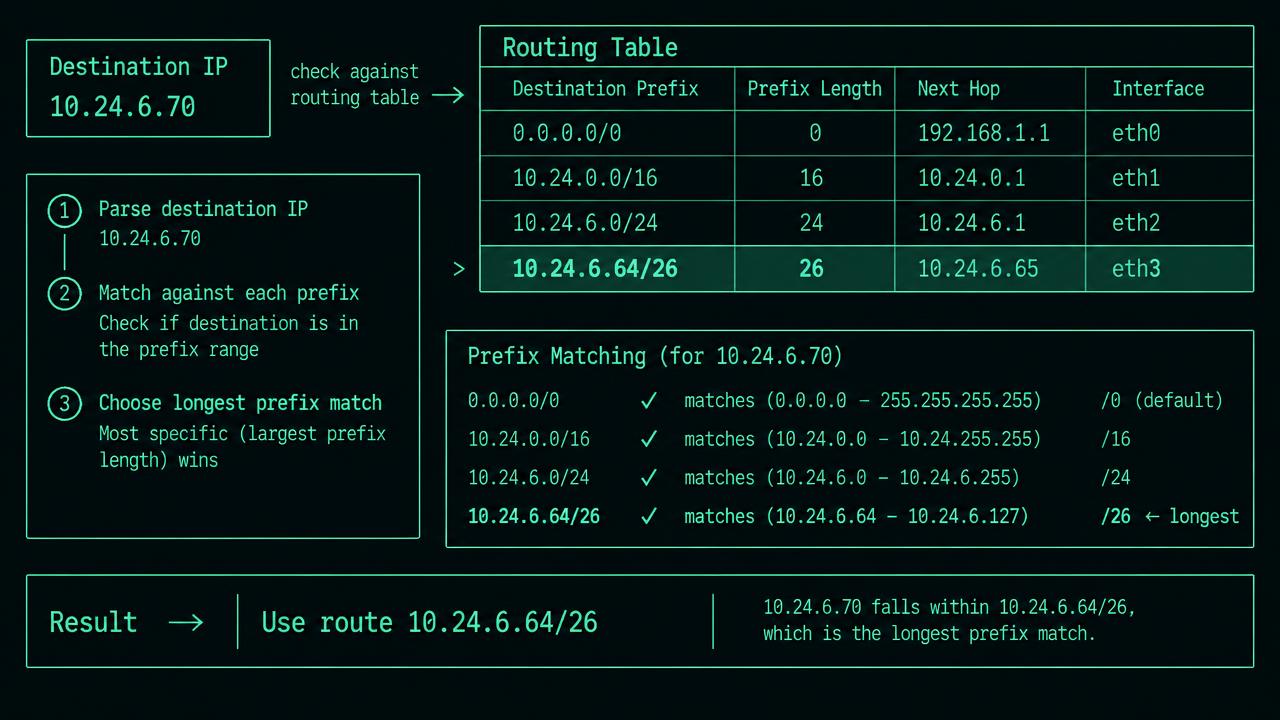
An IPv4 forwarding table associates a destination prefix with a next hop and outgoing interface. For 10.24.6.70, entries for 10.24.0.0/16, 10.24.6.0/24, and 10.24.6.64/26 all match. The /26 wins because its 26 fixed bits are the longest matching prefix; its range is 10.24.6.64-10.24.6.127. A /24 with metric 1 does not beat this /26 with metric 50. Route-source preferences and protocol metrics help choose candidate routes for the same prefix; they do not overturn longest prefix match across different prefix lengths.
The default route 0.0.0.0/0 matches every IPv4 destination but wins only when no more-specific usable route matches. A host at 10.24.6.10/24 sends directly to an on-link destination; for an off-link address it normally resolves the local next hop's link-layer address and sends the frame to its default gateway, 10.24.6.1. The IP destination remains the remote host, not the gateway. The gateway is a device address; the default route is a table entry. More-specific host routes can override that usual default behavior.
For a segmentation review, retain the active forwarding table, relevant interface addresses, and a timestamped route lookup for the protected destination. Ask: which exact prefix and next hop handled this flow at the time? A configuration export alone can miss an inactive route or an unreachable next hop; a default-route screenshot cannot prove the protected subnet took the inspected path.
The longest matching prefix wins even when a shorter prefix advertises a lower metric.
Learned paths change; TTL limits the damage of loops
A static route is configured explicitly and does not learn alternative topology by itself. It is predictable for a small stub network but can blackhole traffic after a failure unless reachability tracking or another recovery mechanism changes it. Dynamic routing exchanges reachability and recalculates paths as topology changes. Distance-vector protocols exchange destination distances with neighbors; RIP is a hop-count example, with 16 representing unreachable. Link-state protocols such as OSPF flood link information within their scope and compute shortest paths from a topology database. Dynamic does not mean instant convergence or automatically trusted advertisements.
During convergence, inconsistent tables can form a loop. An IPv4 packet arriving with TTL 3 can be forwarded by the first router with TTL 2, then by the next with TTL 1; the following router discards it rather than forwarding a zero-lifetime packet, normally returning ICMP Time Exceeded. TTL is a per-packet forwarding bound, not a routing metric, session timeout, or repair mechanism. A route-tracing tool exploits successive expiration points, but filtered or rate-limited ICMP responses mean a missing response is not conclusive proof of a broken hop.
Change controls should record routing neighbors, permitted advertisements, route changes, and measured failover behavior. Restrict protocol participation and authenticate routing exchanges where supported. An auditor can ask whether a newly learned prefix could divert protected traffic and how the team tested convergence. Correlate time-stamped route changes with probes and packet captures; a TTL-expired counter establishes looping symptoms, not the cause or its resolution.
Translate tuples without mistaking them for identities or permissions
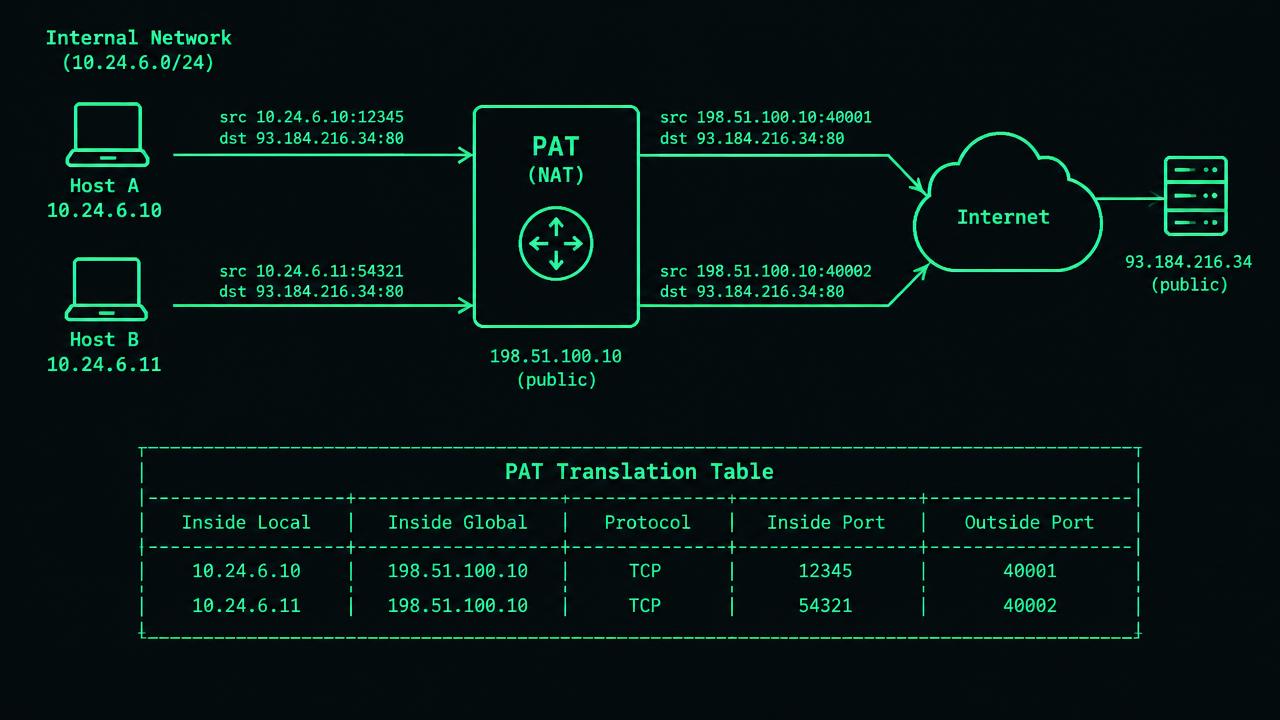
NAT rewrites IP addressing. A static one-to-one mapping can associate an internal address with one external address; dynamic address translation can allocate an address from a pool. PAT, also called address-and-port translation, lets multiple internal sessions share an external IP by distinguishing transport ports. For TCP, 10.24.6.10:51514 to 203.0.113.80:443 might leave as 198.51.100.10:40001 to the same destination. Another internal host can use external port 40002. Translation updates affected checksums and maintains enough mapping state to reverse the rewrite for return traffic.
A reply to 198.51.100.10:40001 is mapped back to 10.24.6.10:51514 while the mapping exists. Mappings expire, ports can be reused, and finite port space can cause exhaustion. An external IP alone therefore cannot identify an internal host. Investigations need synchronized timestamps, protocol, inside and outside address-port pairs, and often the remote endpoint to disambiguate sessions. These logs associate a network endpoint with traffic; separate asset and authentication records are needed to associate a person.
NAT is not a firewall. The lack of a dynamic inbound mapping may incidentally prevent some unsolicited connections, but static translations or port forwards can expose a service and translation itself does not express least-privilege policy. Require explicit traffic rules and positive and negative tests across the boundary. Audit evidence should pair translation records with the actual filtering policy and deny logs; ask whether the same exposure would be blocked if the addresses were not translated.
PAT separates sessions with translated ports; a distinct filtering policy decides which sessions are permitted.
Tasks
Answers are graded on the server: the answer key never reaches your browser.
Task 1: The default-route alibi
Scenario sim+55 XP
Read the brief and answer both questions.
Incident brief
A reviewer sees active routes 0.0.0.0/0 via 192.0.2.1, 10.24.6.0/24 via 192.0.2.3 with metric 1, and 10.24.6.64/26 via 192.0.2.2 with metric 50. All next hops are reachable. The owner says the lowest metric makes the /24 win for destination 10.24.6.70 and calls the catch-all route a default gateway.
1.1Which destination prefix wins for 10.24.6.70? (CIDR notation)
1.2What is the correct name for the catch-all table entry, rather than the gateway device? (two words)
Task 2: A loop is not a timer failure
Scenario sim+55 XP
Read the brief and answer both questions.
Incident brief
After a link failure, two routers briefly send packets back toward each other. Their protocol floods link descriptions and computes paths from a topology database. A coordinator labels it distance vector and says increasing the packet's TTL will fix convergence. A captured IPv4 packet arrives at the first router with TTL 3 and loops until discarded.
Term bank, not all of these are right
link statedistance vectorTTLmetric
2.1Which routing family matches the described topology-database mechanism? (two words)
2.2Which IPv4 header field bounds how many routers can forward the looping packet? (an acronym)
Task 3: The shared-address security claim
Scenario sim+55 XP
Read the brief and answer both questions.
Incident brief
Two internal clients share 198.51.100.10, using translated TCP source ports 40001 and 40002 to reach the same remote service. The security manager calls the mapping table a firewall policy and approves an inbound port forward without any filtering review. The assessor needs the specific translation mechanism and the separate control that must enforce permitted traffic.
Term bank, not all of these are right
PATfirewallstatic routingTTL
3.1Which specific translation mechanism distinguishes these simultaneous sessions by port? (an acronym)
3.2Which separate traffic-policy enforcement control is missing from the review? (one word)
Labs
80 bonus XP
Hands-on work. You edit the artefact, the server runs the checks: the expectations and the reference solution never reach your browser.
A change record claims that the backup destination follows the default path because it has the smallest metric. Complete the forwarding and translation worksheet from the fixture, not from that claim. Treat every listed route as installed and every next hop as reachable.
The same record calls address sharing a security boundary. Record the separate enforcement control and the evidence needed to attribute a shared-address session. Use a boolean for the firewall claim and a numeric value for the packet lifetime after one router forwards it.
Active routes, packet capture, and control requirement
Route prefix       Next hop     Metric
0.0.0.0/0          192.0.2.1   1
10.24.6.0/24       192.0.2.3   1
10.24.6.64/26      192.0.2.2   50
Lookup destination: 10.24.6.70
Separate outbound TCP capture:
 inside 10.24.6.10:51514 -> 203.0.113.80:443, TTL 64 before router
 outside 198.51.100.10:40001 -> 203.0.113.80:443
 A second client shares the outside IP using source port 40002.
Requirement: explicit traffic-policy enforcement; attribution records must
 include time, protocol, and both original and translated address-port pairs.
The network team submits six independent statements for a change approval. Its lead says any healthy route or translation table proves the whole boundary secure.
Accept technically sound statements and reject each defective statement using its single root-cause code. Judge the claims as written, not the team's confidence.
Verdicts are accept or reject. Every rejection needs one reason code from: prefix-selection | routing-model | lifetime-purpose | translation-control.
Change-review statements and reason-code meanings
Codes: prefix-selection = wrong forwarding precedence;
 routing-model = wrong route-learning mechanics;
 lifetime-purpose = wrong purpose for packet lifetime;
 translation-control = translation mistaken for policy enforcement.
NR-1 For 10.24.6.70, an installed reachable /26 matching that address beats a matching /24 even if the /24 metric is lower.
NR-2 0.0.0.0/0 always wins over a matching installed /24 because it covers more addresses.
NR-3 A manually configured static route automatically learns a replacement next hop from neighboring routers when its link fails.
NR-4 Increasing TTL repairs inconsistent forwarding tables and ends a routing loop.
NR-5 Multiple TCP clients can share an outside IP through translated ports; attribution needs timed inside/outside tuple records and protocol.
NR-6 A port forward needs no firewall policy review because translating its destination automatically enforces least privilege.
1
2
3
4
5
6
7
8
9
10
11
12
13
14
15
16
17
18
19
Checks
Every line in the fixture carries a verdict
Accept and reject land on the right lines
Each rejection cites a valid reason code
Next on your path · Networking Fundamentals
Transport and Core Services
Reconstruct transport sessions, address allocation and name resolution without overstating what network evidence proves.